

MAIN IMAGE: Thato Ramaili – PPRA CEO
Feature
The Property Practitioners Regulatory Authority’s recent announcement introducing an alternative competency-based pathway to becoming a non-principal property practitioner has generated considerable discussion across the real estate industry.
Healthy debate is both welcome and necessary whenever significant regulatory reform is introduced. The PPRA values the views expressed by practitioners, employers, educators and industry representative bodies. Equally important, however, is that the discussion remains grounded in the facts, the legislative framework and the realities confronting the industry.
Some commentary has suggested that the Authority is lowering standards or reversing the professionalisation of the industry. Others have questioned the rationale behind introducing an alternative pathway while the existing qualification route remains available.
These concerns deserve a considered response.
Why change was necessary
The PPRA did not introduce this pathway because the Authority believes qualifications lack value.
It introduced the pathway because the existing system has not produced the outcomes it was intended to achieve or enabled effective implementation of the qualification framework within the timeframes prescribed by the Property Practitioners Regulations and there is no evidence that it has produced better-equipped Property Practitioners.
The Authority also notes that the Skills Development Providers now opposing the alternative competency-based pathway have themselves, over the 18 years since the introduction of the mandatory qualification framework, publicly identified significant shortcomings in its implementation. These have included challenges associated with the transition to the Occupational Qualification, delays and uncertainty relating to the EISA assessment process, the continued absence of a qualification pathway for Principal Property Practitioners, and the ongoing difficulties experienced in enabling learners to successfully progress through the current education and assessment system.
These challenges reinforce the Authority’s conclusion that maintaining the status quo is neither sustainable nor in the long-term interests of the property sector.
The Authority’s own data presents a compelling and unavoidable conclusion: the existing qualification framework is failing to progress candidates through the system in the manner originally intended.
| Year | Total FFCs Candidates | Total FFCs | % Candidates | No of Candidates Completed NQF4 | % of Candidates Completed NQF4 | No of Candidates Obtained Equivalency Exemption | % of Candidates with Equivalency Exemption |
| 2017 | 20 001 | 41 241 | 48.5 | 6 066 | 30.3 | 530 | 2.6 |
| 2018 | 22 077 | 43 638 | 50.6 | 1 093 | 5.0 | 604 | 2.7 |
| 2019 | 25 031 | 45 955 | 54.5 | 930 | 3.7 | 563 | 2.2 |
| 2020 | 20 858 | 40 958 | 50.9 | 890 | 4.3 | 430 | 2.1 |
| 2021 | 23 473 | 43 802 | 53.6 | 342 | 1.5 | 330 | 1.4 |
| 2022 | 30 933 | 52 384 | 59.1 | 693 | 2.2 | 682 | 2.2 |
| 2023 | 20 465 | 40 633 | 50.4 | 2 307 | 11.3 | 843 | 4.1 |
| 2024 | 10 556 | 16 414 | 64.3 | 726 | 6.9 | 533 | 5.0 |
| 2025 | 6 088 | 7 670 | 79.4 | 1 374 | 22.6 | 756 | 12.4 |
| 179 482 | 332 695 | 56.04% Average | 14 421 | 9.75% Average | 5 271 | 3.9% Average |
*Note: Figures for 2023 to 2025 should be interpreted in the context of the introduction of the 3-year FFC.
On average, almost half of all registered property practitioners remain candidates. Even more concerning is that only a small percentage of candidates complete the prescribed NQF Level 4 qualification each year, while the number obtaining equivalency exemptions is similarly modest.
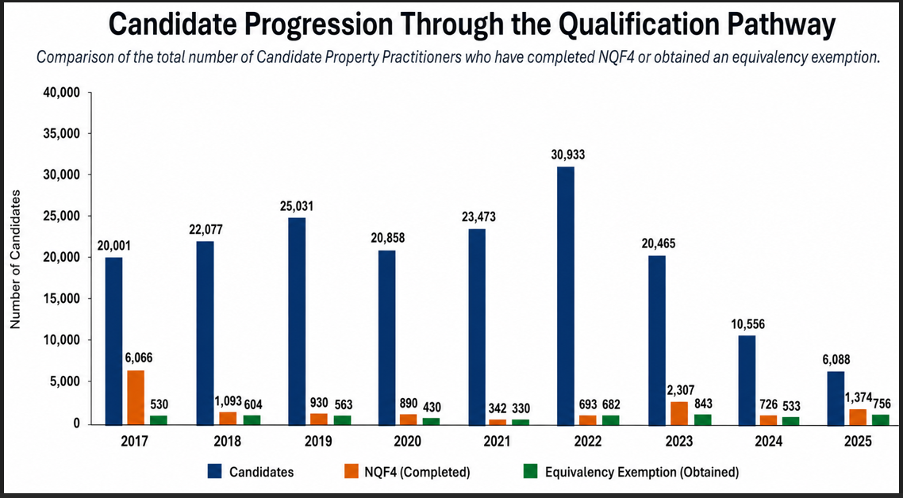
The issue is not only whether education is important. The issue is also whether the regulatory framework is achieving its intended purpose.
A regulatory system must be judged by outcomes, not merely by intentions.
A regulatory responsibility
The Authority has a duty to give effect to its Regulations.
Application of the 180-day candidate limit will result in the deregistration of thousands of candidate property practitioners, placing livelihoods at risk and creating significant disruption for an industry that contributes meaningfully to economic activity and employment.
This state of affairs was inherited from the Estate Agency Affairs Board and the Authority is now confronted with an unavoidable question: does it deregister almost half the industry, or does it implement a lawful solution that gives practical effect to the Regulations? The implication is also that thousands of candidates are operating as estate agents without the PPRA having any information as far as the level of education of those candidates are concerned.
The new pathway will ensure that successful candidates have at least matric, and will have passed the PPRA exam and completed 6 practical courses within 180 days.
Aligning practice with the regulations
The introduction of the alternative pathway is also intended to resolve practical challenges that have arisen in implementing the current framework.
Regulation 33.4.5 provides that no person may act as a candidate property practitioner for more than 180 days in aggregate without the consent of the Authority, after which the candidate is required to sit for the Professional Designation Examination as a non-principal property practitioner.
Similarly, Regulation 33.2.6 expressly states that a person need not first be registered as a candidate property practitioner before becoming entitled to study for, sit examinations for and achieve the prescribed qualifications.
The alternative competency-based pathway has therefore been designed to better align implementation with the existing regulatory framework while ensuring that every practitioner continues to demonstrate competence before qualifying as a non-principal property practitioner.
Maintaining high standards
One of the most frequently raised questions has been whether the introduction of an alternative pathway lowers professional standards.
The answer is unequivocally no.
The introduction of an alternative pathway does not remove the requirement to demonstrate competence.
Every candidate following this pathway will still be required to successfully pass a rigorous PPRA examination that assesses technical knowledge, legislative understanding and industry competence before qualifying as a non-principal property practitioner.
Candidates must complete 6 modules of structured practical training designed to develop the skills required for practice.
PPRA will diligently enforce regulations 33.3.1 and 33.3.2 in that these candidates will only be able to operate under supervision of a qualified property practitioner, and for a period of six months following the date after they achieve non-principal status, all their mandates and agreements of sale and rent have to be co-signed by a qualified practitioner who has reviewed said contracts to ensure that they comply with industry norms and standards.
Professional competence can never be measured by theoretical instruction alone. It must be developed through the combination of industry knowledge, practical application, supervision, ethical conduct and assessment.
The new pathway retains all of these elements.
Consumer protection remains paramount
Some stakeholders have expressed concern that the alternative pathway could compromise consumer protection.
Consumer protection remains at the heart of the PPRA’s regulatory mandate.
Importantly, the introduction of an alternative pathway does not amend or dilute the regulatory safeguards contained in Regulation 33.
Candidate property practitioners must still work under the active supervision and control of a qualified property practitioner and for the first six months after becoming a non-principal property practitioner, may not independently conclude mandates or agreements for the sale, purchase or letting of property.
These statutory supervision requirements remain unchanged.
Equally important, the PPRA Code of Conduct remains fully applicable to every registered property practitioner. The ethical duties, professional obligations and disciplinary framework governing the industry have not been amended by the introduction of the alternative pathway. Practitioners who fail to comply with these obligations remain subject to the Authority’s enforcement and disciplinary processes.
Does this reverse professionalisation?
Professionalisation is not defined solely by the number of qualifications required.
Professionalisation is achieved through ensuring that practitioners possess the industry competence, ethics, accountability and practical skills necessary to serve the public.
The alternative pathway does not diminish these objectives. Rather, it provides another route to achieving them.
Importantly, the PPRA has not abolished qualifications. The existing qualification pathway remains available.
Choice should not be confused with lower standards.
Does the new pathway make education and training providers redundant?
The PPRA recognises and values the contribution made by accredited education and training providers over many years. Their work has played an important role in training practitioners.
The introduction of an alternative pathway should not be viewed as diminishing that contribution, nor does it remove the existing qualification pathway. Rather, it presents an opportunity for the sector to evolve in response to the changing needs of the industry.
Training providers will continue to deliver qualifications, prepare candidates for the PPRA examinations and support ongoing industry development.
In fact, some SDPs have already broadened their offerings beyond formal qualifications to include personal development programmes, workplace coaching, leadership development, communication and negotiation skills, client relationship management, business development, sales excellence and other essential capabilities that support long-term industry success.
These areas of development are increasingly recognised as integral to building competent, ethical and successful property practitioners. While technical knowledge and regulatory compliance are fundamental, many of the skills that distinguish outstanding practitioners are developed through continuous learning, practical experience and targeted personal development throughout a practitioner’s career.
Transformation and access
The Property Practitioners Act requires the PPRA to promote transformation within the property sector.
Expanding access to the industry forms part of that statutory responsibility and should not be interpreted as lowering of standards.
The Authority believes it is possible to broaden access while maintaining rigorous standards of competence.
These objectives are complementary, not contradictory.
International perspective
South Africa is not unique in requiring candidates to demonstrate competence through licensing, examinations, practical experience and regulatory oversight.
Many mature property markets like the UK, US and UAE similarly assess competence through licensing, examinations, supervised practical experience and continuing professional development, recognising that capability is developed through multiple complementary mechanisms rather than through a single educational model.
The PPRA has considered these international approaches while developing a framework appropriate for South Africa’s legislative environment and the realities of our property sector.
Looking ahead
The PPRA will shortly publish a Practice Note setting out the implementation framework, transitional arrangements and operational requirements of the alternative competency-based pathway. This will address many of the questions raised by stakeholders and provide greater regulatory certainty and clarity as implementation progresses.
This article was supplied by Thato Ramaili the CEO of the PPRA